
How an Offhand Comment About a Mascot Turned Into Something More
Key Idea
What started as a casual comment—“We should have a mascot”—evolved into a layered exploration of identity, symbolism, and decision-making. Along the way, students applied ideas across contexts, questioned default systems, and created a moment of genuine community—showing how meaningful learning often grows out of real experiences.
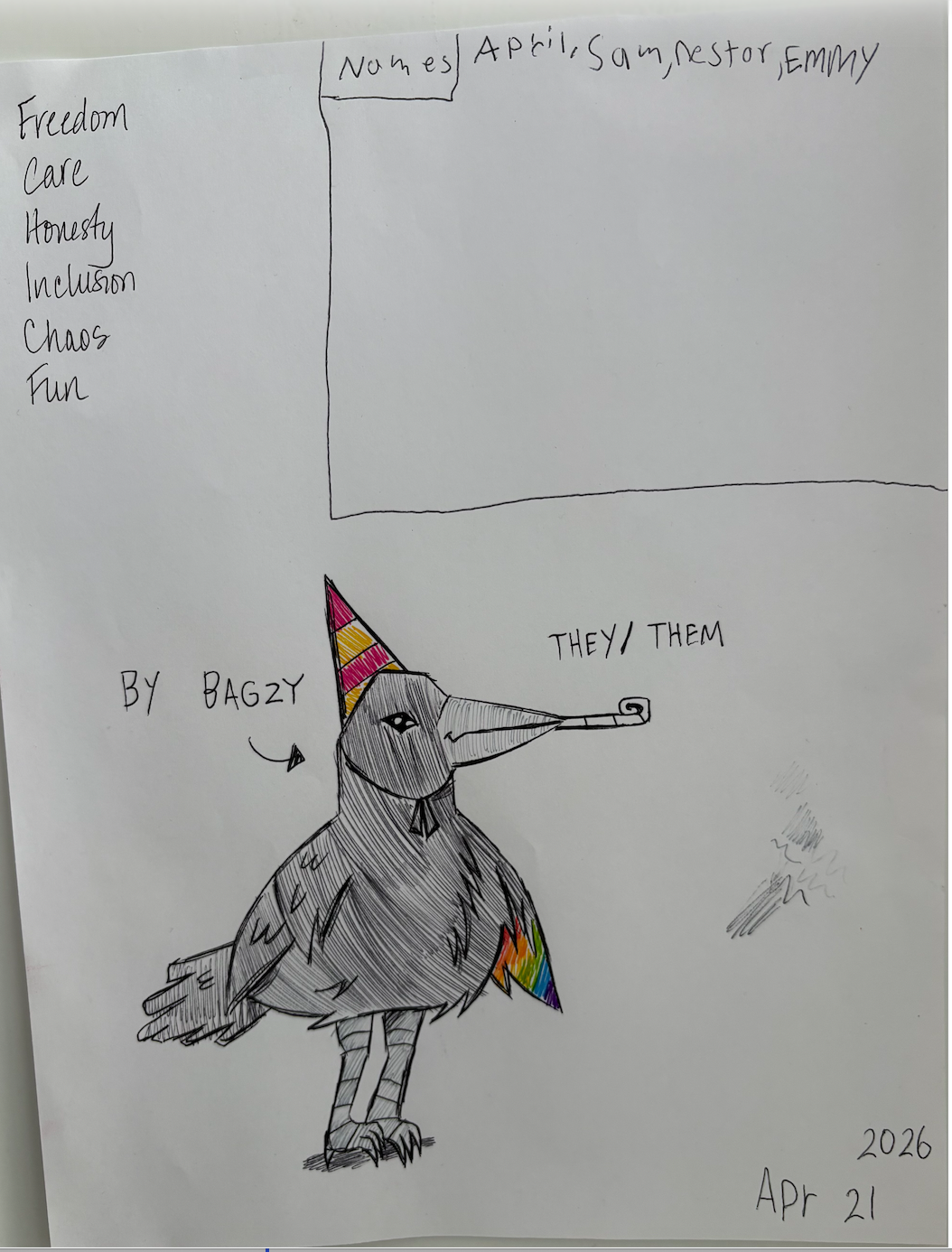
The crow mascot, designed by one of our students as part of this ongoing conversation. Shared with permission.
Some of the most meaningful learning moments at Embark don’t start with a plan.
They start with something small.
Recently, it was an offhand comment:
“Hey—we should have a mascot!”
At first, it was just that. But like many moments here, it didn’t stay small for long.
From a Passing Idea to a Real Conversation
What began casually quickly turned into a thoughtful discussion.
Students started talking about animals—not just which ones they liked, but how different animals behave, what they symbolize, and what they represent. The conversation moved well beyond preference into meaning.
Along the way, they began sorting animals into different classifications—thinking about what “group” or “class” a mascot might belong to, and what that implied.
What does this animal say about us?
What qualities actually feel aligned?
There was also a sense that some symbols have already been claimed. Several students noted that “school” and “education” have long been associated with the owl—often used as a stand-in for intelligence—and that it felt like a misappropriation.
There was energy around the idea of “taking back the bird.”
Why the Crow
Over time, the group gravitated toward the idea of a crow.
Not because it’s the obvious choice, but because it isn’t.
Students were drawn to its complexity:
highly intelligent
adaptable
observant
and, in many stories, a bit of a trickster
It felt more aligned—less about projecting a narrow version of “smart,” and more about embracing something layered and real.
A Community Moment
As the idea took shape, another layer emerged.
One of our students—who isn’t in the space every day but is very much part of the community—is an incredibly talented artist. It felt natural to ask her to create the mascot.
She was commissioned to design it.
It became a really meaningful moment—not just about the mascot itself, but about recognizing and valuing someone’s gift. There was a shared sense of appreciation, and of making space for someone to contribute something uniquely theirs.
When the Process Caught Up
At one point, a poll was created to choose a name.
And then…folks moved on with their day.
It wasn’t until later that day, during a current issues class, that the earlier decision-making process came back into focus.
In that class, students were discussing different systems—first consent-based decision making, and then ranked-choice voting.
That’s when the connection clicked.
Students who had been part of the earlier mascot conversation immediately recognized the disconnect:
The poll they had started using didn’t actually reflect how decisions are usually made here
It didn’t align with the idea of finding a path forward that works for everyone, rather than just a majority
There was a noticeable shift.
Reworking the Process
Instead of continuing with the poll, students chose to revisit the process.
They began:
redesigning how the decision would be made
creating ballots that could support ranked-choice voting
researching how those systems work in practice
thinking through how this could connect with the consent-based approach they’re already familiar with
What stood out wasn’t just the use of these systems—it was the desire to apply them in a real situation that mattered to them.
This wasn’t hypothetical.
It was a live decision, being shaped in real time.
More Than a Mascot
By the end of the day, the mascot itself almost felt secondary.
What remained was something much more significant:
a conversation about identity
an exploration of animal behavior and classification
a critique of default systems
a connection between different areas of learning
and a moment of genuine community
What started as an offhand comment had become something shared, intentional, and meaningful.
Why Moments Like This Matter
From the outside, this might look like a group of students deciding on a mascot.
From the inside, it’s something else entirely.
It’s students:
exploring animal behavior and classification
thinking about symbolism and identity
applying ideas from current events to a real decision
questioning default systems and redesigning them
and shaping the way their community functions
None of this was planned in advance.
It emerged from a moment that mattered to them.
This is often what learning looks like here—not something separate from life, but something that grows directly out of it.
