
Key Idea
At Embark Center, each student is supported by a dedicated mentor, but learning extends far beyond that relationship. Volunteers, including community members, and young alumni, help create a dynamic, multi-age environment where ideas, skills, and perspectives are constantly exchanged. Some contribute through classes or one-on-one support, while others engage more informally. Together, they help create a community where students and volunteers are shaped by the experience.
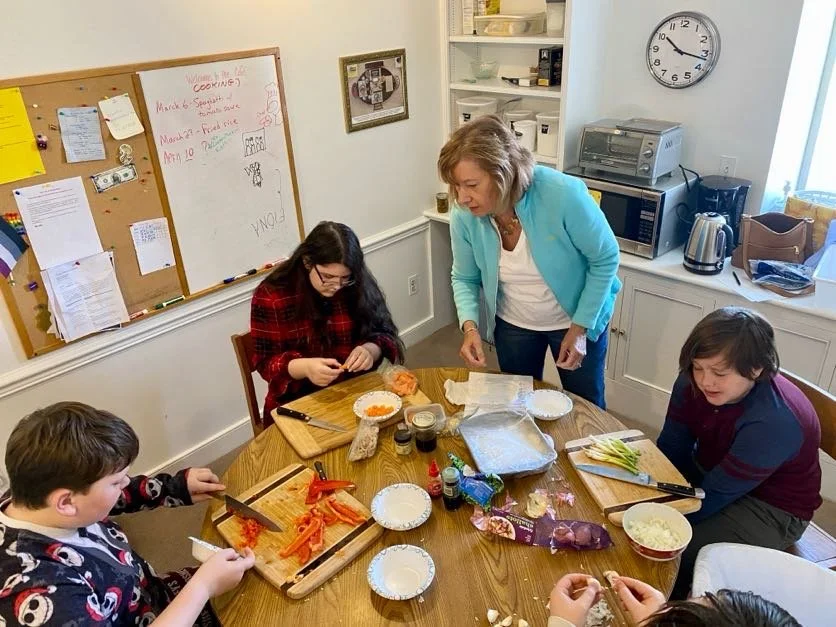
When people hear the word volunteer, they often imagine a clearly defined role: tutoring, assisting, helping where needed.
At Embark Center, it doesn’t quite work that way.
Volunteers aren’t stepping into a single, rigid role. They’re not responsible for guiding a student’s overall path. That role belongs to our staff mentors, who build consistent, supportive relationships with each student over time.
Volunteers do something different.
They expand the environment.
More Than One Adult, More Than One Path
At Embark Center, every student has a mentor, a steady presence who helps them navigate goals, challenges, and growth. That relationship provides consistency and depth.
Volunteers bring something mentors alone can’t: a wider world.
They show up with their own interests, experiences, and ways of thinking. They might be artists, engineers, writers, entrepreneurs, retirees, or simply curious people who enjoy being part of a learning community. Some are young alumni who once sat in the same space as current students. Others are homeschooled high schoolers looking to contribute and connect.
They’re not all doing the same thing, and that’s the point.
What Volunteers Actually Do
Volunteers at Embark Center show up in a range of ways.
Some offer structured classes or workshops based on student interest. They share skills in areas like art, coding, music, or hands-on crafts. Others work one-on-one with students who want to develop a specific skill or pursue a project in more depth.
And just as often, volunteers participate more informally by joining conversations, offering ideas, and collaborating alongside students as opportunities arise.
While volunteers aren’t responsible for guiding a student’s overall learning path, they play an important role in expanding what’s possible within the environment.
Some of these interactions are planned. Many are not.
What Happens in a Shared Space
When people of different ages and backgrounds come together, something subtle but important happens.
A student asks a question. A volunteer shares an experience. Someone offers an idea, a tool, a perspective. Over time, familiarity grows. Trust builds.
Relationships form, not because they were assigned, but because they emerged through shared work and conversation.
Students begin to see adults not just as authority figures, but as real people with varied paths and interests. They learn how to communicate across ages, how to ask for help, and how to engage in meaningful dialogue.
And just as importantly, they see that there isn’t just one way to move through the world.
Learning Across Ages
One of the things that makes Embark Center unique is that learning doesn’t happen in age-based silos.
Younger students interact with teens. Teens collaborate with adults. Alumni return with new experiences and perspectives. Experienced students step into the role of contributor rather than just learner.
At Embark Center, the line between “student” and “contributor” isn’t fixed—it shifts over time.
A student who once needed support may come back ready to offer it. Someone who is still figuring things out may find themselves helping someone else do the same.
That kind of environment doesn’t just support learning; it reflects real life.
What Students Gain
Because of volunteers, students experience something broader than a single mentoring relationship.
They:
encounter different ways of thinking and problem-solving
engage with people outside their immediate peer group
build confidence interacting with a range of adults
pursue interests through both structured opportunities and informal exploration
see learning as something that happens everywhere—not just within a plan
They also begin to understand something deeper: that learning is not something delivered to them, it’s something they participate in, shape, and share.
What Volunteers Discover
What’s easy to overlook is how much this experience goes both ways.
Volunteers often come in expecting to give.
Many leave surprised by what they receive.
Some rediscover what it feels like to learn without pressure or evaluation. Others find their assumptions about young people challenged in the best possible way. They see firsthand what kids are capable of when given trust, time, and space.
For young alumni, volunteering can be a moment of reflection, a chance to recognize how much they’ve grown and to step into a new kind of responsibility.
And for many, something simple but powerful happens: they form real relationships that matter.
A Community, Not a Program
Embark Center isn’t just a place where students learn.
It’s a place where people come together across ages, experiences, and roles, and something meaningful emerges from that mix.
Mentors provide the steady thread in a student’s journey.
Volunteers add texture, perspective, and unexpected connections along the way.
And over time, the distinction between learner and contributor becomes less important than the shared experience of being part of something real.
With Gratitude
To all of our volunteers, whether you’ve been part of Embark for years or just recently joined us, thank you.
You help make this community what it is.
And whether you realize it or not, you’re part of something that reaches further than any single moment, conversation, or project.
