
What Does the First Week at Embark Center Look Like?
The first week at Embark Center looks and sounds, a little different from the first week at most schools.
Students are laughing, talking, playing games, and reconnecting after the summer. There are no bells telling them when it's time to stop what they're doing and move somewhere else. Instead of rows of desks, you'll find comfortable couches, cozy chairs, art and science supplies, games, and spaces where people can gather together or find somewhere quiet.
There aren't class schedules waiting for students when they arrive, either. We don't even know what all of our fall classes will be yet. That's something we'll begin figuring out together.
Our first few days are about reconnecting, welcoming new students, learning (or relearning) how Embark Center works, and beginning to create the year together.
Reconnecting
We begin Tuesday morning gathered around the art table in the studio for a meet and greet. Returning students catch up after months apart, new students begin getting to know everyone, and we share stories and ask questions.
Then we move up to the loft, our largest indoor gathering space, for orientation.
We share names and pronouns and introduce new students to some important Embark Center lore. Returning students explain the band name wall, the quote book, the plastic rat that lost its tail, the Truman Show stickers hidden throughout the building, the stories of the Johnston family who once lived here for over 150 years, and whether or not there are ghosts!
Learning the history and inside jokes of a place is part of becoming part of it.
Then we get into the practical stuff: How does this place actually work?
Yes, you can sleep. Yes, programming is noncompulsory. Yes, you can play video games and bring your own devices. We have quiet spaces, noise-canceling headphones, and fidgets. We talk about favorite places to visit in downtown Leesburg, how students can safely go into town, and how safety works within our building.
We also invite students to attend Community Meeting and a mock conflict resolution circle so they can see how decisions and disagreements are handled here.
And because orientation is better with pizza, we treat everyone to lunch before finishing the day with party games led by one of our students.
Creating the Year Together
On Wednesday, we start putting some of those ideas into practice.
Community Meeting happens every morning from 9:45–10:00, unless we need to schedule a longer meeting. During our first week, we review how it works: announcements, circle and class reports, issues, proposals, and thank-yous and compliments. We also talk about how anyone can create a proposal and how to call a full Community Meeting when a decision will affect everyone.
Then comes one of our favorite parts of the beginning of the year: proposing and scheduling fall classes.
Instead of staff creating a complete course schedule before students arrive, we find out what people actually want to explore. Students and staff propose possibilities, see who else is interested, and begin building the schedule together.
Sometimes a class needs a minimum number of committed participants to work. If there aren't enough people interested, it may not make the schedule, and that's okay. An interest can sometimes become a 1-on-1 instead: two people exploring something together without needing to turn it into a class.
We approach field trips similarly. Interested students and staff gather to talk about possibilities and work through the logistics of making them happen.
We also set aside time for mentors and mentees to meet. New students learn how mentor meetings work, and everyone begins scheduling their regular meeting times.
Little by little, the year starts taking shape.
Practicing How We Live Together
By Thursday, we're ready to practice some of the systems we've been talking about.
During a mock conflict resolution circle, students choose a pretend conflict and act it out while a student or staff member serves as mediator. We introduce the basic “recipe” we use for mediation and some of the foundations of Nonviolent Communication: observations, feelings, needs, and requests.
We also offer a sample class so new students can experience what an Embark Center class can feel like before the regular schedule begins.
Meanwhile, the Cleaning Circle gets to work. Everyone at Embark Center has a cleaning job, so the circle figures out what needs to be done, how many positions we need with this year's group, and how the jobs will be divided.
Having agency in a shared space also means helping to care for it.
Heading Into Town
One of the advantages of being in the Johnston House in downtown Leesburg is that our community extends beyond our front door.
During the first week, returning students take new students on a walking tour of town. They point out favorite stores (the candy shop is, unsurprisingly, important), restaurants, and places to spend time.
We also talk about safety, navigating town independently, and what it means to be out in the community representing Embark Center—and, more broadly, kids and teens.
Then there's one more very important stop: our celebratory trip to Gruto's for ice cream.
And Then We Ask How It Went
Before we finish the week, we make time to talk about how it went.
That matters.
This year, for example, we heard that some of our orientation icebreakers made people uncomfortable and that students didn't want to do them again next year.
So we won't.
It's a small example, but perhaps one of the best ways to understand self-directed and democratic education. We can tell students that their voices matter. We can explain consent, agency, proposals, Community Meeting, and all the ways they can participate in shaping Embark Center.
But those things mean much more when students discover that what they say can actually change what happens next.
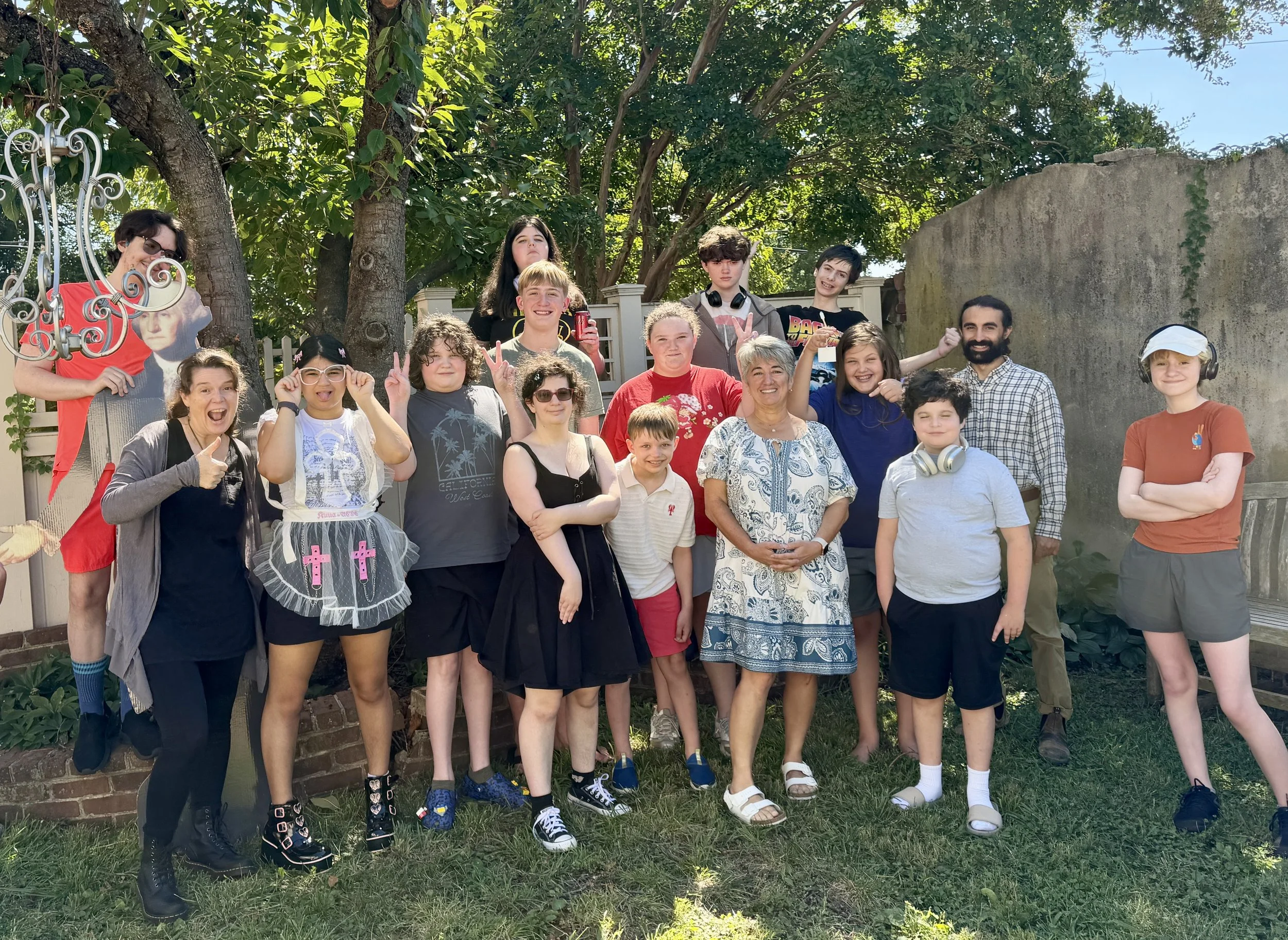
By the end of our first week, we've taken our first group photo, eaten pizza and ice cream, heard some questionable ghost stories, created classes, planned field trips, practiced conflict resolution, explored downtown Leesburg, met with mentors, figured out what needs to be cleaned, and begun reconnecting with old friends and making new ones.
The year isn't planned yet.
We're just getting started.
Curious about how Embark Center works? Click here to learn more.
